
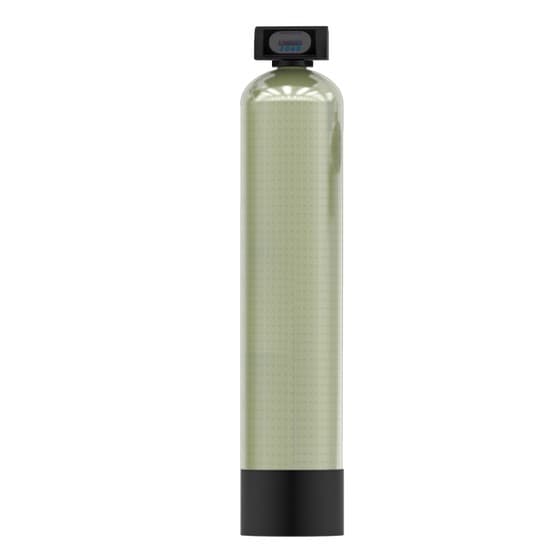
Automatic carbon filter AquaLong CF 9
€2,129
The AquaLong CF carbon filter is used to remove chlorine, organic and organochlorine compounds and improve the organoleptic properties of water.
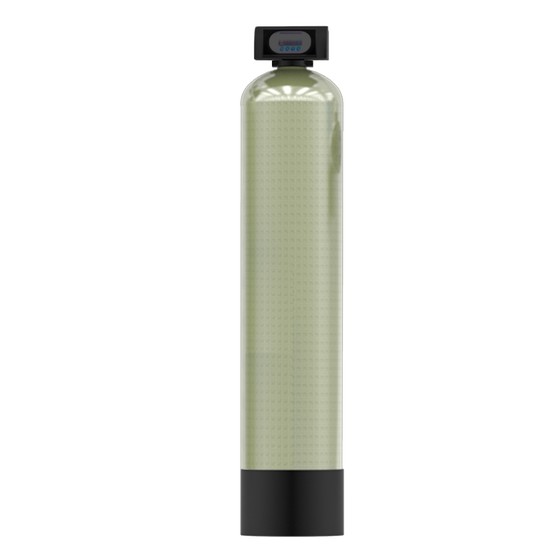
The AquaLong CF 9 carbon filter is used to remove chlorine, organic and organochlorine compounds and improve the organoleptic properties of the water.
Use
The carbon filter is used as a stand-alone filter or as a post-filter after other filters (softener, multifilter, nitrate removal filter) in apartments, family houses, in small, medium and large enterprises.
Charcoal filter:
- improves the taste and smell of water,
- It removes chlorine, pesticides and heavy metals.
How to choose the right carbon filter
Carbon filters are distinguished by the flow rate (and volume of the filter media). To find out what type of filter you need, you need to make the following calculation:
- Count the maximum number of people who can turn on the water at the same time. Here you must take into account all taps, showers, bathrooms and toilets and people who live with you or can visit you. The flow rate from 1 tap is 7 l/min or 7 x 60 min = 420 l/h or 0.42 m3/h.
- Multiply the number of taps (people) by the flow rate of one tap.
- Choose a nitrate filter whose flow rate is higher than the value you obtain.
For example:
- Let's say your family consists of 4 people, plus guests can come, and the maximum number of taps open at the same time is 6.
- Multiply the number of taps (people) by the flow rate of one tap: 6 x 0.42 = 2.52 m3/h.
- The flow rate of your filter should therefore be higher than 2.52 m3/h.
Design and principle of operation

- Filter housing (filter column). The filter housing is made seamless from food-grade glass fibre. This ensures maximum strength and corrosion resistance. The bushing is a hollow cylinder with a spherical top and bottom. The case is fixed to the base. In the upper part, there is a neck for filling and emptying fillers (gravel and activated carbon). The socket has an internal thread for mounting a control valve.
- Runxin control valve with time-based regeneration. It is adjusted once when installing the filter.
- Drainage and distribution system. It consists of a vertical tube and other elements that prevent the filter media from washing out of the housing during filter operation. The control valve with the upper cap attached is screwed into the housing, which slides it onto the tube.
- The filter media is a Kekwa 12x30 filter material, which is made of coconut shell directly at the place of cultivation. It is characterized by high strength (> 98.5%), increased surface area (> 1100 m2/g), low ash content dissolved in water. The strength of Kekwa activated carbon exceeds the mechanical strength of birch charcoal by more than 1.5 times. Activation of charcoal is carried out by superheated steam at a temperature of 800-1000 ° C. It is designed to remove chlorine, organic and organochlorine compounds and improve the organoleptic properties of water. It requires regular flushing to remove retained solids and redistribute the filter material.
- Base layer of gravel on which the filter media is laid. The total volume of the filling is about 2/3 of the volume of the case. The free space above the media is necessary in terms of the expansion of the filter media during backwashing.
Technical information
| Pressure tank: | 21" x 62" |
| Maximum water flow, m3/h: | 3,56 |
| Quartz sand (3-5 mm), kg: | 50 |
| Filter media (activated carbon) Kekwa 12x30, liter: | 196 |
| Control unit: | Runxin F75Q1 |
| Connection: | 2" |
How to find out the dimensions of the filter:
Look at the dimensions of the tank (1" = 2.54 cm) and add 12 cm to the control unit.
The AquaLong CF automatic sand filters differ only in dimensions. The principle of operation is the same